- Local
- Buying Advice
The Best Time of Year to Install Flooring in Oklahoma
For hardwood the season genuinely matters. For everything else, it matters far less than the salesperson telling you to book now.

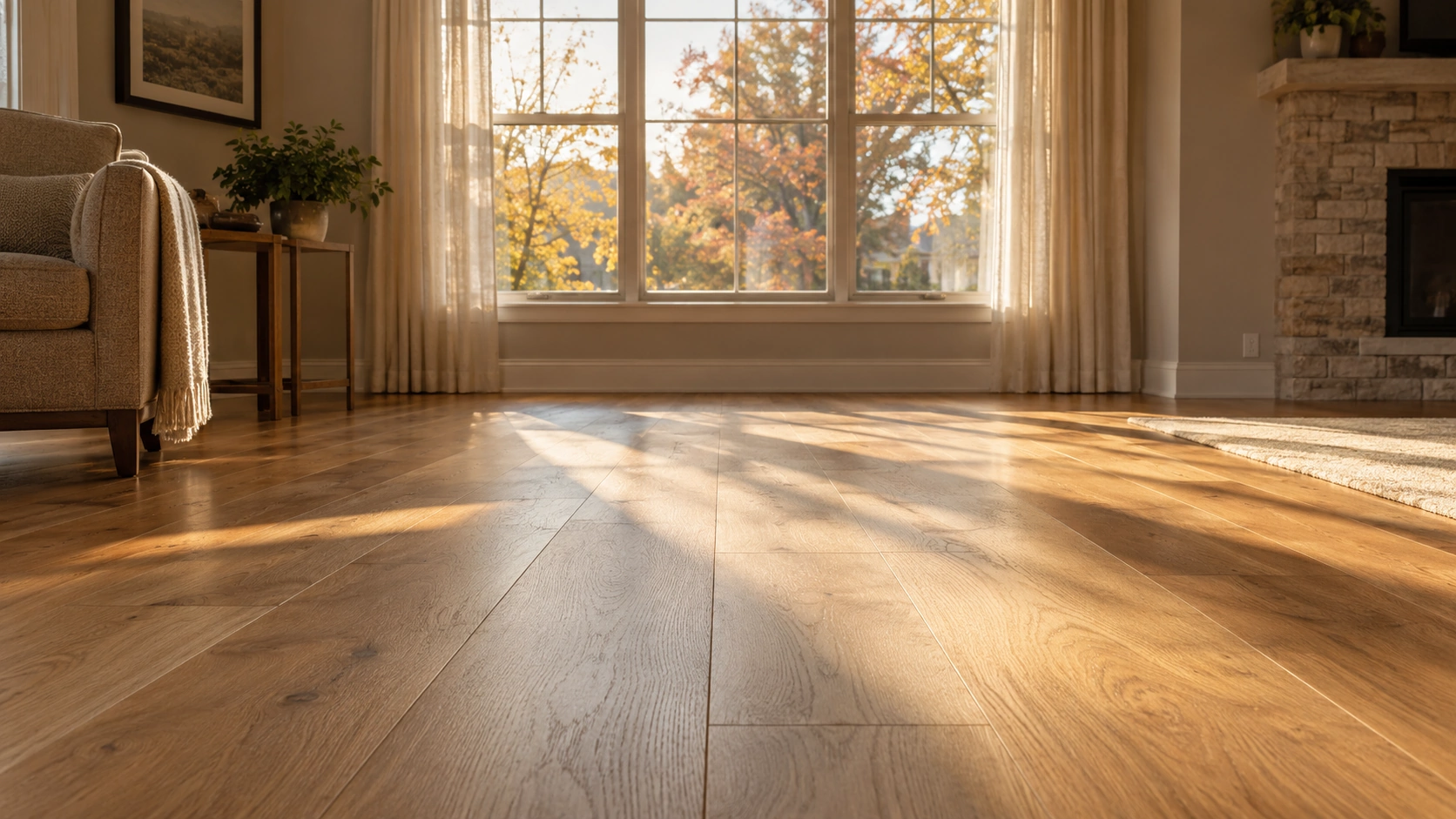
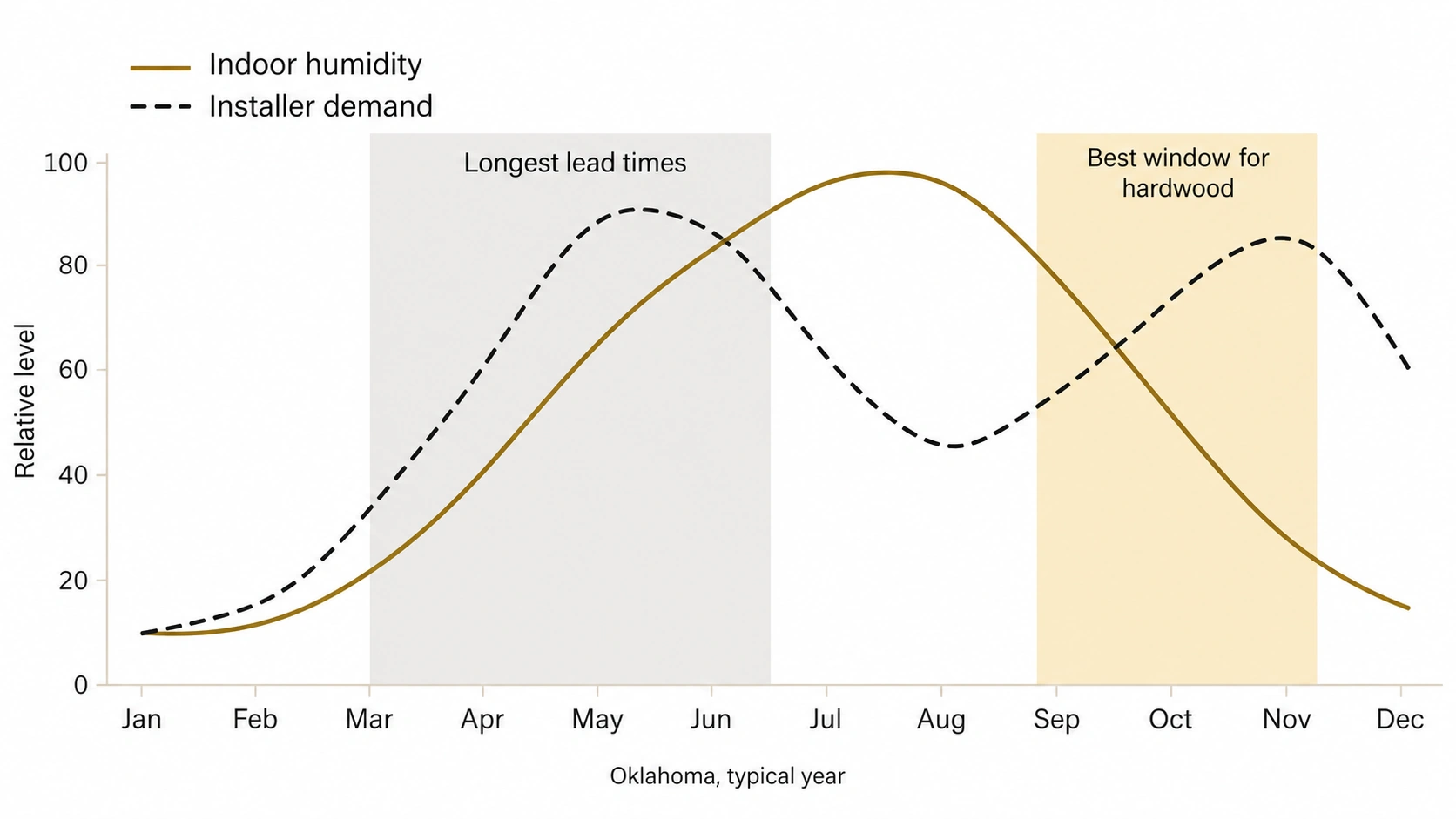
Fall is the best time to install hardwood in Oklahoma, and for luxury vinyl plank, laminate or tile it makes almost no difference at all.
That is the whole answer, and it is worth saying plainly because the flooring industry has a habit of turning “book now” into a seasonal argument that does not hold up.
Here is what actually changes through the year, and what does not.
Why the season only matters for wood
Every material we install reacts to the room it sits in. Wood reacts the most, because wood is still doing what it did as a tree: taking on moisture when the air is damp and giving it back when the air is dry.
Oklahoma gives it plenty to react to. Summers here run humid, and winter indoor air with the heat cycling gets genuinely dry. A wood floor breathes with that. It grows slightly across the width of every board in July and shrinks again in February.
That movement is normal and it is designed for. What matters is where in that range the floor was when we installed it.
Install a hardwood floor in the middle of a humid August and the boards go down already swollen near the top of their range. Come February they shrink, and the gaps between boards are wider than they would otherwise be. Install in the depths of a dry January and the opposite happens: the boards are at their narrowest, and the following summer they expand into whatever space is available. If the expansion gap at the walls is not generous enough, that is when a floor cups or peaks.
Install in the fall and the wood starts near the middle. It has less distance to travel in either direction, so the seasonal change you notice is smaller.
The National Wood Flooring Association publishes the acclimation and moisture guidance this all rests on, and it is the reason we take a moisture reading on both the subfloor and the wood rather than working to a calendar.
What this means per material
| Material | Does the season matter? | Best window | Why |
|---|---|---|---|
| Solid hardwood | Yes, genuinely | Late September to November | Starts nearest the middle of its seasonal range, so it moves less afterward |
| Engineered hardwood | A little | Fall preferred, any month workable | Cross ply core moves far less than solid, but it is still wood |
| Luxury vinyl plank | No | Any month | Rigid core is dimensionally stable across normal indoor swings |
| Laminate | Barely | Any month | Fiberboard core is stable in a conditioned house; keep it away from moisture year round |
| Tile | No | Any month | Porcelain does not move. Cold slabs only affect mortar cure time, which we plan around |
If you are putting in plank or tile and somebody tells you the season is a reason to book this week rather than next, that is a sales tactic and not a technical argument.
The part nobody mentions: the calendar of other people
The stronger seasonal argument has nothing to do with materials.
Spring and early summer are the busiest stretch of the year for every flooring installer in the Tulsa metro. March through June is when listings go up, when tax refunds land, and when everyone decides at once that the carpet has to go. Lead times stretch. The good crews book out.
Fall is quieter right up until it is not. From about the second week of October, the calendar starts filling with people who want the house right before family arrives. By early November, most of the honest answers about timing have turned into “not before Christmas.”
So the real fall advantage is not humidity. It is that you can still get a decent installer on a reasonable date.
If you want it done before the holidays
Work backward, not forward. The date that matters is when you want your house back, not when you want us to start.
Plank floors, luxury vinyl or laminate. One to five days of install for most homes, depending on square footage and how much prep the subfloor needs. Add a week or two for scheduling and material.
Tile. Longer, and not because of the tile. Mortar and grout need cure time between stages, and that time is not compressible. A bathroom is a few days. A large kitchen and entry runs longer.
Hardwood. Add acclimation before anything gets installed. The material sits in the actual room, at the temperature and humidity it will live in, until it stabilizes.
Anything with a subfloor problem. Self leveler needs to cure. Refastening a squeaky deck adds a day. This is the variable that moves timelines most, and it is the reason we check flatness and moisture at the estimate rather than discovering it on install day. There is more on that in our guide to subfloor prep.
Booking six to eight weeks ahead of the date you care about is comfortable. Six to eight days is not, and we would rather tell you that now than take the deposit and disappoint you in November.
The one time of year we push back
Late spring and summer, on solid hardwood, in a house that is not yet air conditioned to its normal setting.
We see this on new builds and on renovations where the HVAC is not running yet. The crew acclimates the wood in a house sitting at ambient summer humidity, installs it, and then the owner moves in and runs the air conditioning at 72 degrees for the first time. The house dries out fast, the floor shrinks fast, and gaps open in the first few months.
That is not a defect in the wood and it is not bad workmanship. It is a floor that acclimated to conditions the house was never going to keep.
If that is your situation, the fix is straightforward: get the HVAC running at its normal setting before the wood is delivered, not after. We will ask about this at the estimate, and if the answer is that the system is not on yet, we would rather push the date than install into it.
The new build question
If you are flooring a house before you move in, do it before the furniture arrives.
An empty house is faster to install, cheaper in labor because nothing gets moved twice, and cleaner at the walls because we are not scribing around a sofa somebody cannot lift. It is one of the few situations where the better result and the lower cost point the same direction.
The one thing that overrides this is a young slab. Concrete keeps releasing moisture for a long time after it is poured, and a slab still above the manufacturer’s limit will break a glue bond months after handover. On a recent build we take a reading before specifying anything that has to bond to it. If the number says wait, waiting is genuinely the cheaper option.
So when should you actually book?
You want hardwood: aim for fall. If you have missed it, fall is still not a hard requirement, it just means the expansion gap and the acclimation have to be right, and you should ask any installer how they are handling both.
You want plank or tile: whenever suits you. Pick the month that fits your life, not the one that fits a promotion.
You want it done before the holidays: call in September or early October. That is the honest cutoff, and it moves earlier every year that the metro grows.
You are between materials: the season should not be the deciding factor. What is under your floor matters more, and so does the room it is going in. Our comparisons of engineered vs solid hardwood and wood look tile vs real hardwood both get into that.
If you want a straight read on your house, we will come look at it. We measure the rooms, check the subfloor for flatness and moisture, and give you a written line item quote with a realistic date on it rather than an optimistic one. Call (918) 219-4848 or request a free estimate, and if the honest answer is that your job should wait until spring, we will tell you that too. You can see the materials we install on our flooring services pages.