- Comparisons
- Materials
Engineered vs Solid Hardwood for Tulsa Slab Homes
Both are real wood on the surface. What is underneath decides which one your house can actually take.

Engineered hardwood is real hardwood. That is the first thing to clear up, because “engineered vs real hardwood” is how a lot of people search for this, and the framing is wrong in a way that costs homeowners money.
The surface you see and walk on is a genuine slice of oak, hickory, maple, or whatever species you chose. Same tree, same grain, same finish. What differs is what sits underneath it.
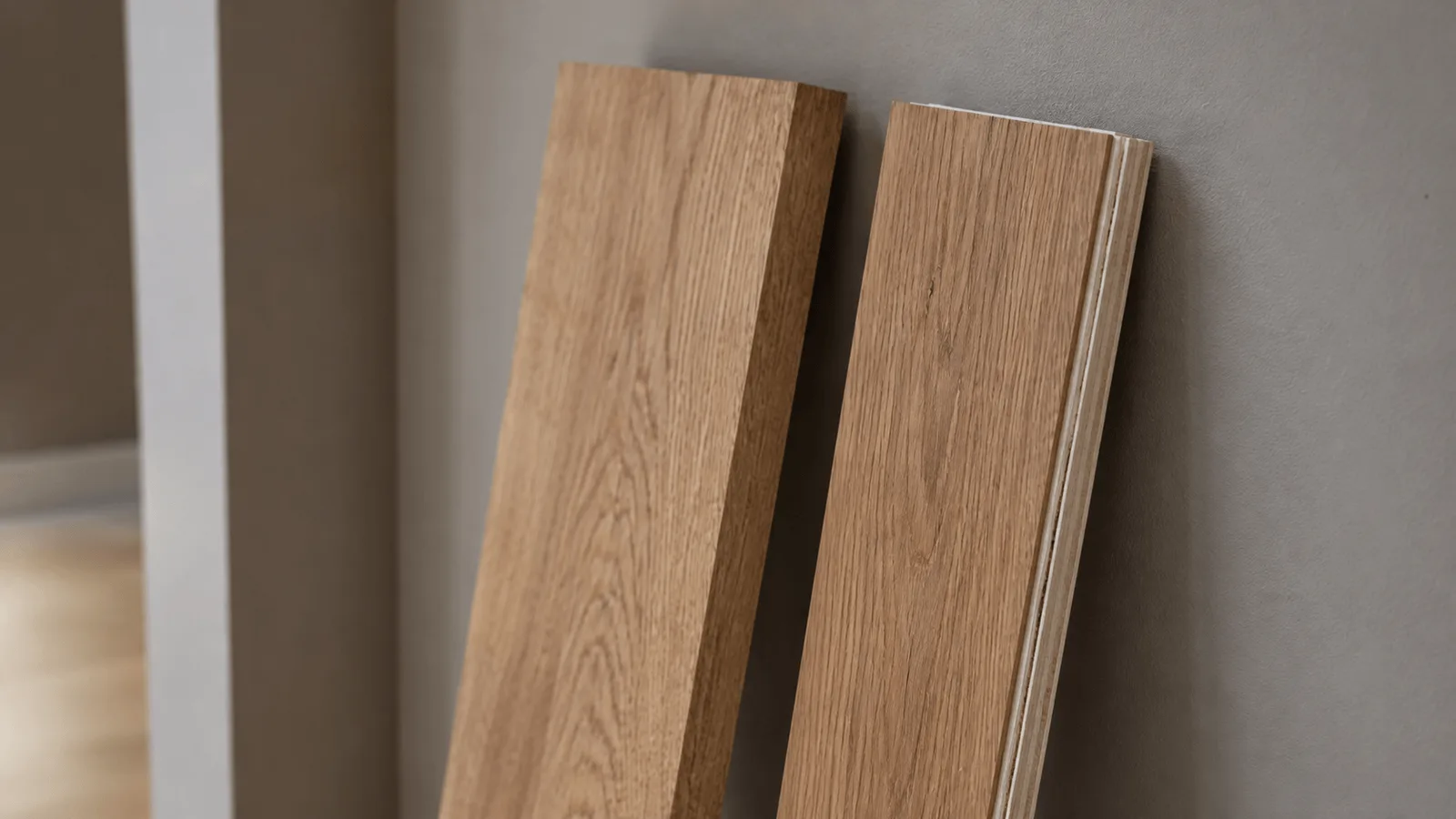
Solid hardwood is one piece of wood all the way through, typically three quarter inch thick. Engineered hardwood is a real wood wear layer bonded to a core of thin wood plies stacked at right angles to each other. Put the two cut ends next to each other and the difference is obvious in a second.
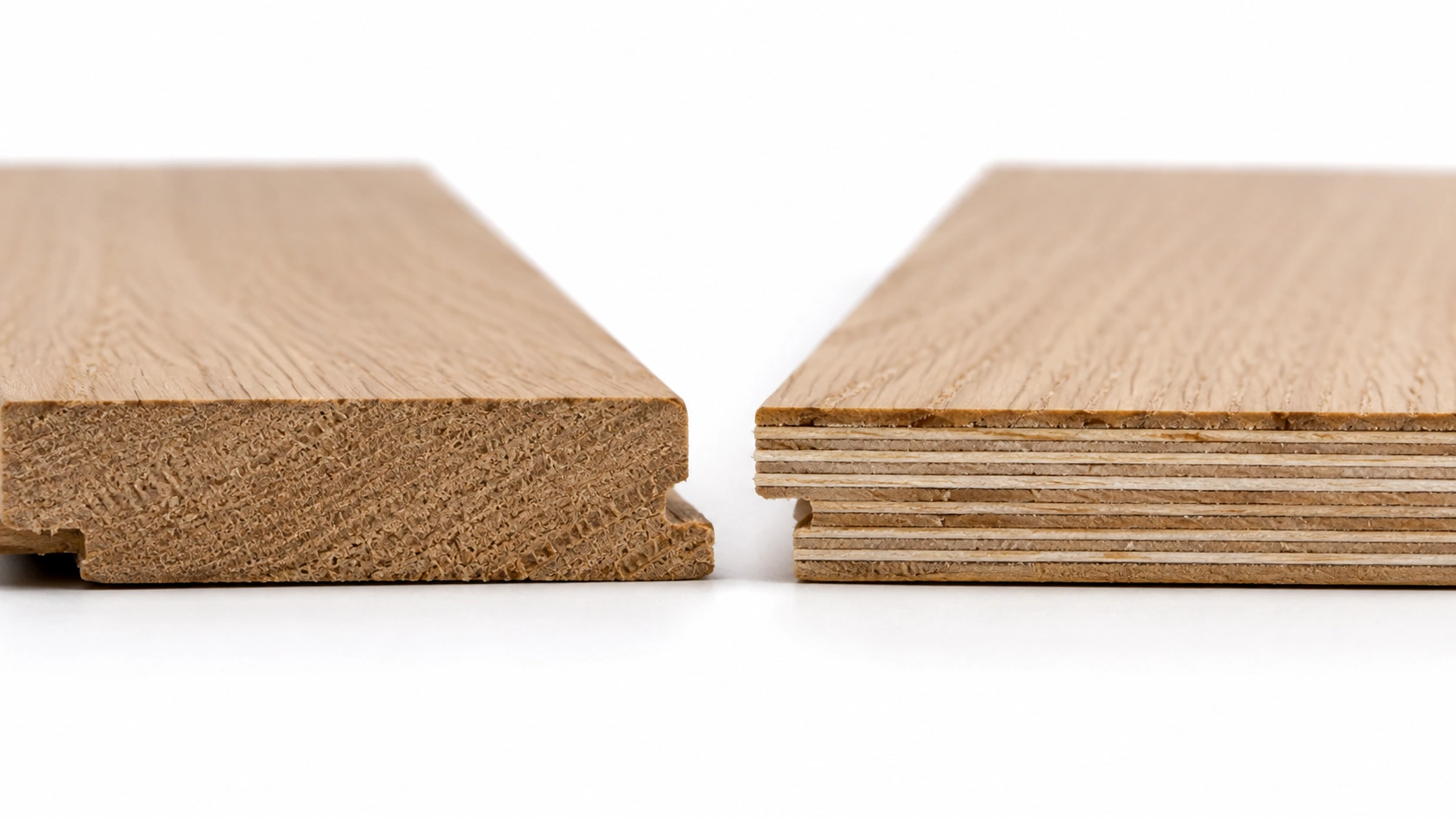
Neither of these is laminate. Laminate is a photograph of wood printed on paper under a melamine coating, over a fiberboard core. It is a good product and we install a lot of it, but it is a different category entirely.
Why the cross ply core exists
Wood moves. Specifically, wood expands and contracts far more across the grain than along it. Take a wide solid board, put it in a house that goes from a humid Tulsa July to a dry January, and it will grow and shrink across its width every year for the life of the floor.
The cross ply core cancels most of that out. Each layer wants to move in the direction its own grain runs, and the layer above and below it, running at ninety degrees, holds it. The result is a plank that barely changes dimension with humidity.
That single property is why engineered exists, and it is why it is the right answer for a large share of Tulsa homes.
The slab problem
A lot of houses in the Tulsa metro are built on a concrete slab rather than over a crawlspace.
Concrete carries moisture. Even a slab that looks bone dry is moving water vapour upward continuously, and it will keep doing that for the life of the house. Put a solid three quarter inch board on top of it and the underside of that board takes on moisture that the finished top side cannot release. The board cups, meaning the edges rise relative to the centre, and once a floor cups the only fix is sanding it flat and hoping the cause was temporary.
Solid hardwood over a slab is not a risk we weigh. It is a failure we decline to install.
Engineered handles it, glued down or floated, with the right moisture mitigation between the slab and the floor. That is a real line item on the quote, and it is one of the things a cheap bid quietly leaves out.
The number that decides whether you overpaid
If you take one thing from this article, take this.
Ask for the wear layer thickness in millimetres, and ignore the overall plank thickness.
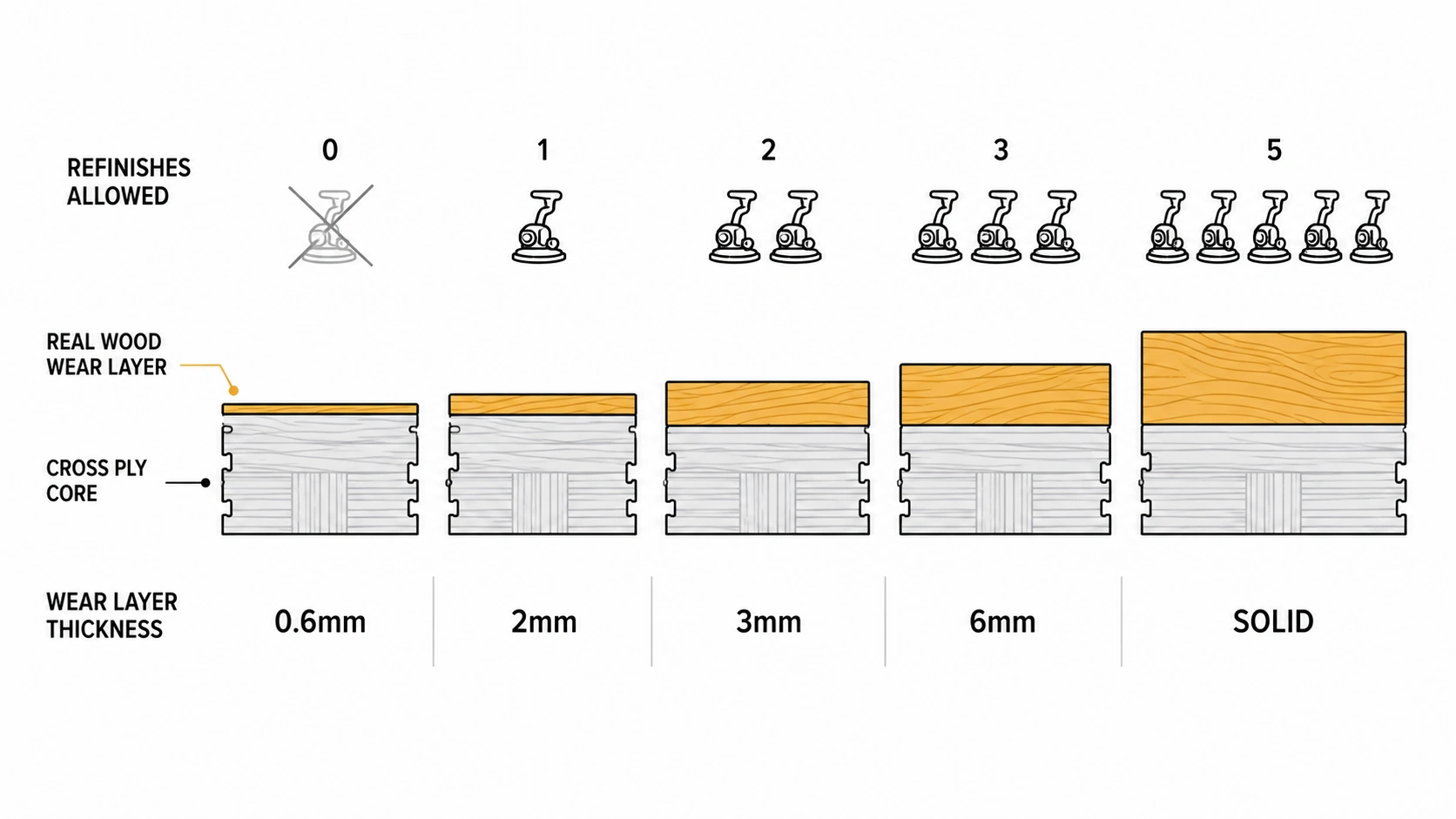
Overall thickness tells you almost nothing. A 12mm engineered plank with a 0.6mm wear layer can never be sanded. A 10mm plank with a 3mm wear layer can be sanded twice. The thicker plank is the worse floor, and it will usually be sitting next to the thinner one at a similar price with “12mm” printed in large type on the tag.
| Wear layer | Refinishes | Really meant for | Our take |
|---|---|---|---|
| 0.6 to 1mm | None, ever | Builder grade, rentals, flips | One deep scratch is permanent. If you are keeping the house, this is not hardwood value |
| 2mm | One light sand | Normal residential | The realistic minimum if you want the option later |
| 3mm | One to two | Long term family homes | Where we point most Tulsa homeowners |
| 4 to 6mm | Two to three | Closest thing to solid | A genuine fifty year floor if you are staying put |
| Solid, 3/4 inch | Four to five | Wood subfloors, upper levels | The most refinishes available, if the house can take it |
The step from 2mm to 3mm is usually a smaller price jump than people expect, and it is the difference between one refinish and two. That is roughly twenty years of floor.
What solid still wins
Refinish count. Four or five sandings against two or three. Over fifty years that is a floor that gets renewed twice more.
Restaining. Because you can take more material off, you have more freedom to sand back to raw wood and go a completely different colour in fifteen years. Engineered at 2mm gives you one careful attempt.
Resale language. Appraisers and listing agents write “solid hardwood” differently to “engineered hardwood,” fairly or not.
The long game. If the house is on a wood subfloor and you intend to be there for decades, solid is the better asset.
What engineered wins
Stability. Far less seasonal movement, which in Oklahoma is not a small thing.
Slabs, basements, and radiant heat. All three are engineered only.
Wide planks. A 7 or 8 inch solid board is a cupping risk in this climate. The same width in engineered stays flat. If you want the wide plank look that is currently everywhere, engineered is how you get it without a callback.
Cost. Usually lower for the same species and grade, and the gap widens as the boards get wider.
What we ask before recommending either
- What is the subfloor? Slab or wood. This answers it more often than anything else.
- Which level? Basement is engineered. Ground floor over a slab is engineered. Upper floor over plywood can be either.
- How wide do you want the boards? Over about 5 inches in this climate, we lean engineered.
- How long are you staying? If the answer is decades and the subfloor allows it, solid earns its premium. If it is under ten years, it very likely does not.
- Is there existing hardwood to match? We identify what is already down before specifying, rather than guessing at species and finish.
Both need the same thing to succeed
Whichever you choose, the install matters more than the product.
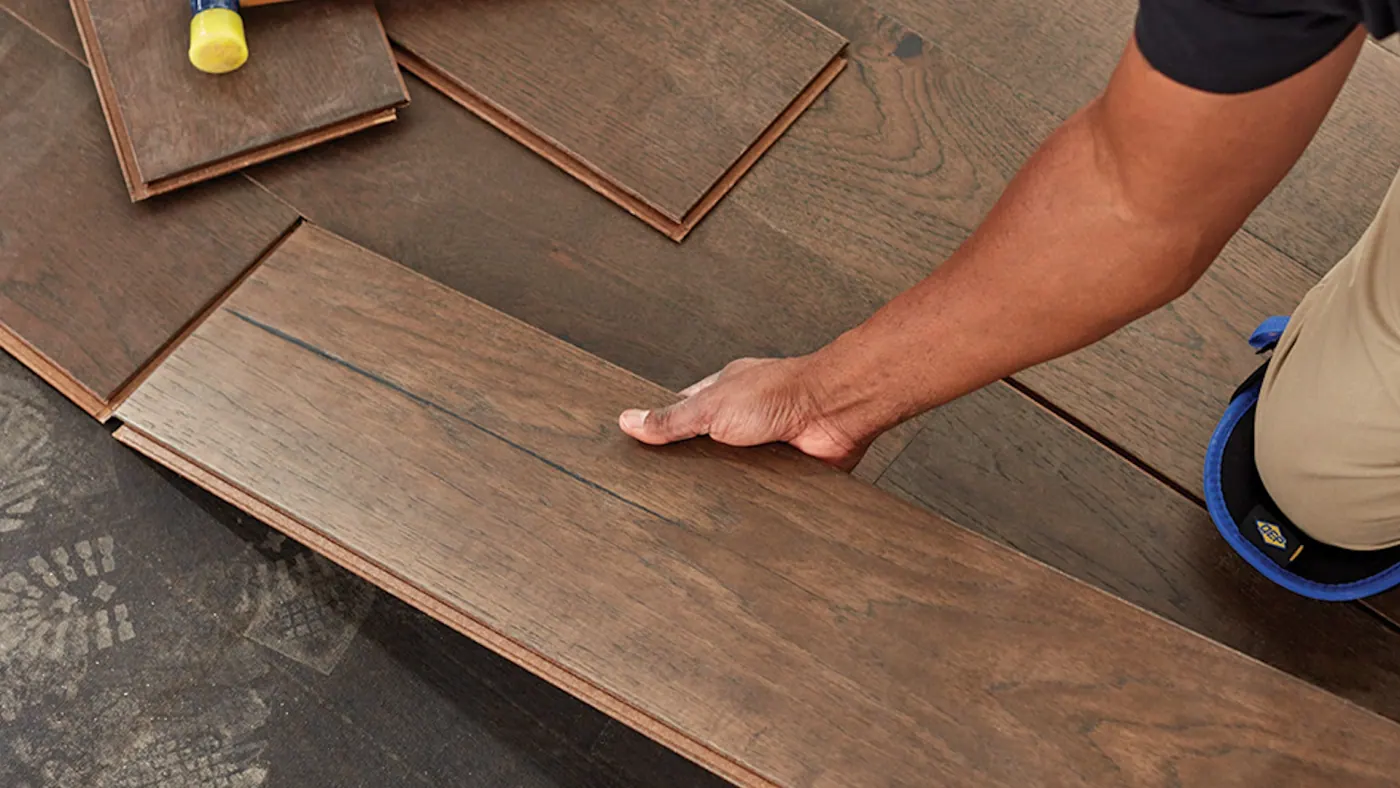
Wood has to acclimate in your house until its moisture content matches the rooms it is going into. Not for a fixed number of days on a calendar, but until the meter says so. We take readings on the wood and the subfloor and record them. Skipping this is the single most common cause of gaps in January and cupping in July, and it is invisible on the quote.
The layout also has to be planned from the longest sight line in the house, with boards racked so no two similar planks land next to each other. That is a craft decision, not a material one, and it is most of what separates a floor that looks designed from one that looks delivered.
The short version
Over a slab or in a basement, or if you want wide planks: engineered, at 3mm wear layer or better.
Over a wood subfloor on an upper level, if you are staying decades: solid.
In either case, ask for the wear layer number in millimetres before you compare two quotes. It is the one spec that separates a floor you can renew from a floor you will one day throw away, and nobody volunteers it.
We will check your subfloor, take moisture readings, and tell you which one your house can take before we talk about species. Request a free in home estimate, or read more on our hardwood flooring installation page.
Related reading: LVP vs Laminate: Which Holds Up Better in an Oklahoma Home?