- Luxury Vinyl Plank
- Buying Advice
Luxury Vinyl Plank Flooring Problems, and What Actually Causes Them
Most LVP failures are installation failures. The product only causes a short list of them, and the owner causes a couple more.

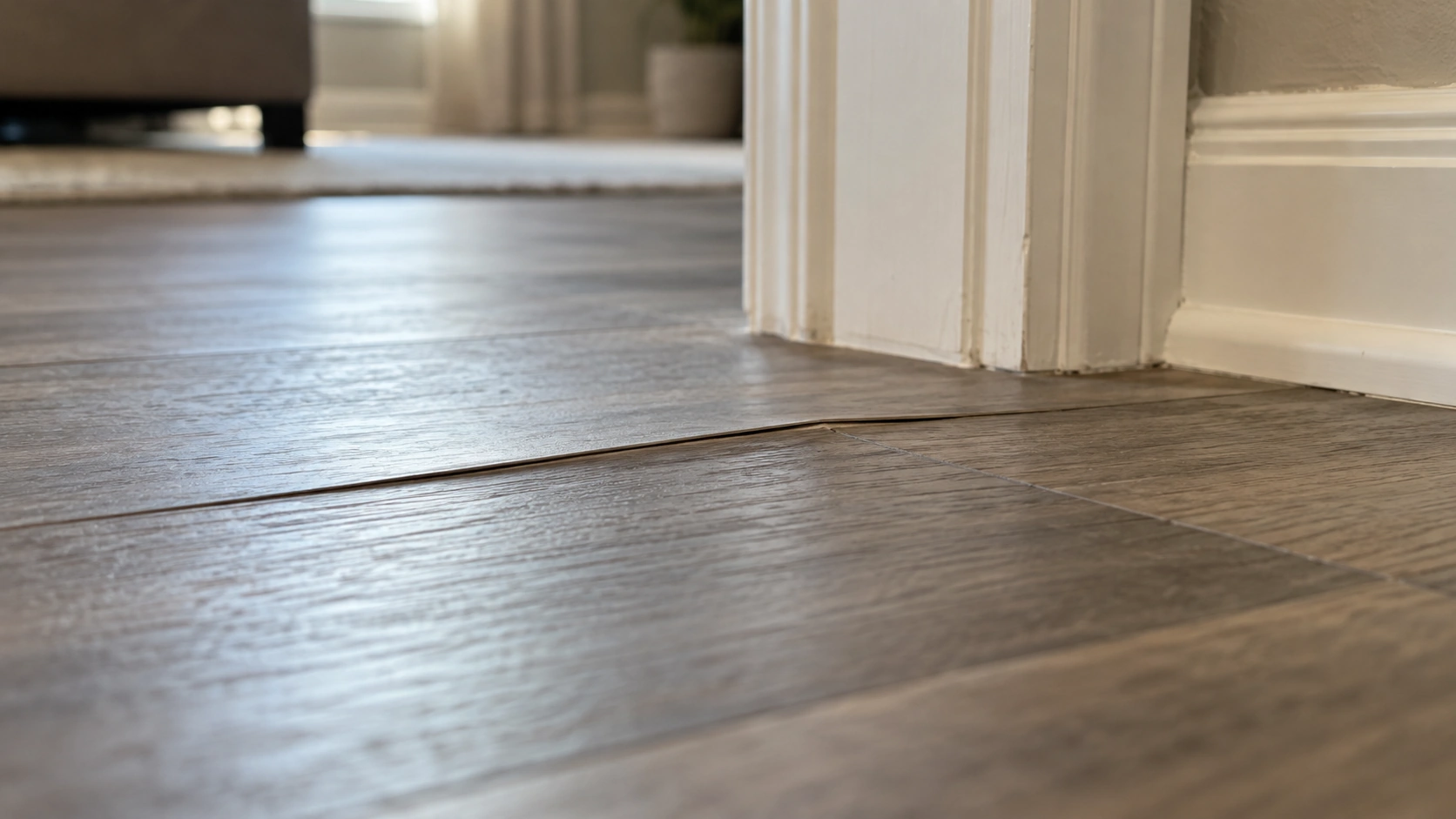
When a luxury vinyl plank floor peaks, gaps, clicks or bounces, the plank itself is rarely the problem. Most LVP failures are installation failures. The product causes a short list of problems, and the owner causes a couple more without realising it.
That matters because the fix depends entirely on the cause. Replace a peaked floor with a better product and install it the same way, and it will peak again.
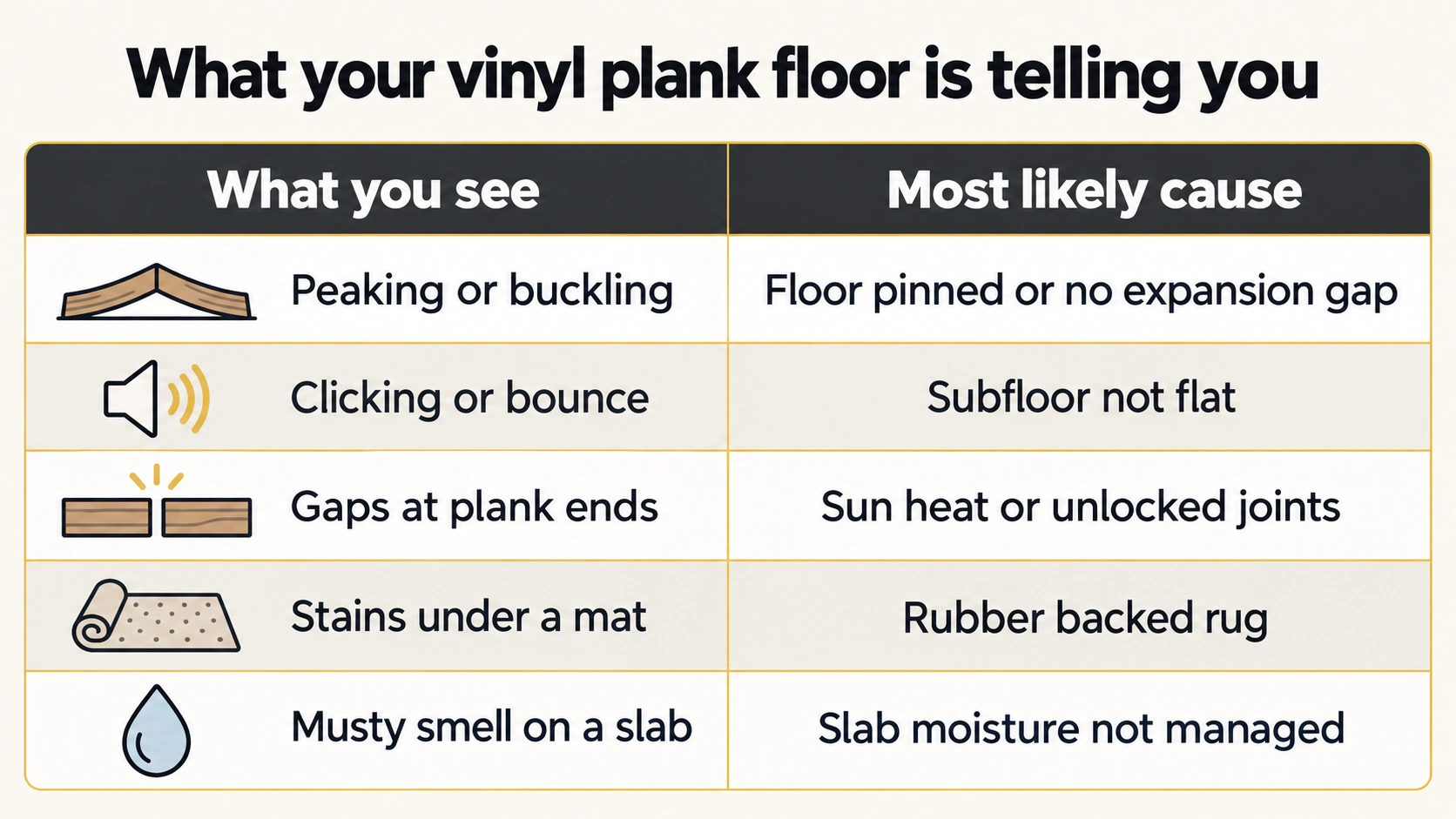
Here is how to read what your floor is telling you.
The quick diagnosis
Find what you are seeing in the left column.
| What you see | Most likely cause | Whose problem | Fixable without a full redo? |
|---|---|---|---|
| Floor lifting or peaking at a doorway or mid room | Floor pinned down, or no expansion gap at the walls | Installation | Often, by freeing the floor |
| Clicking, popping or a hollow bounce in one area | Subfloor not flat under that spot | Installation (prep) | Sometimes; the dip has to be corrected |
| A line of separated joints across the room | Subfloor flexing under that line | Installation (prep) | Usually needs that section lifted |
| Gaps at plank ends, worst near windows | Strong sun heating one area, or joints never fully locked | Sun or installation | Often |
| Dents from furniture or appliances | Heavy point loads on a softer core | Product choice | Plank replacement |
| Fading or warping in front of a window | Direct sun, especially on dark planks | Product and setting | Plank replacement plus shading |
| Yellow or brown stains under a mat | Rubber backed rug or mat reacting with the vinyl | Owner | Usually permanent on those planks |
| Surface scratches worn through | Wear layer too thin for the household | Product choice | Plank replacement |
| Musty smell or dampness at the edges on a slab | Slab moisture not tested or not managed | Installation | Needs lifting and a moisture fix |
Now the detail behind the ones we get asked about most.
Peaking and buckling: the floor cannot move
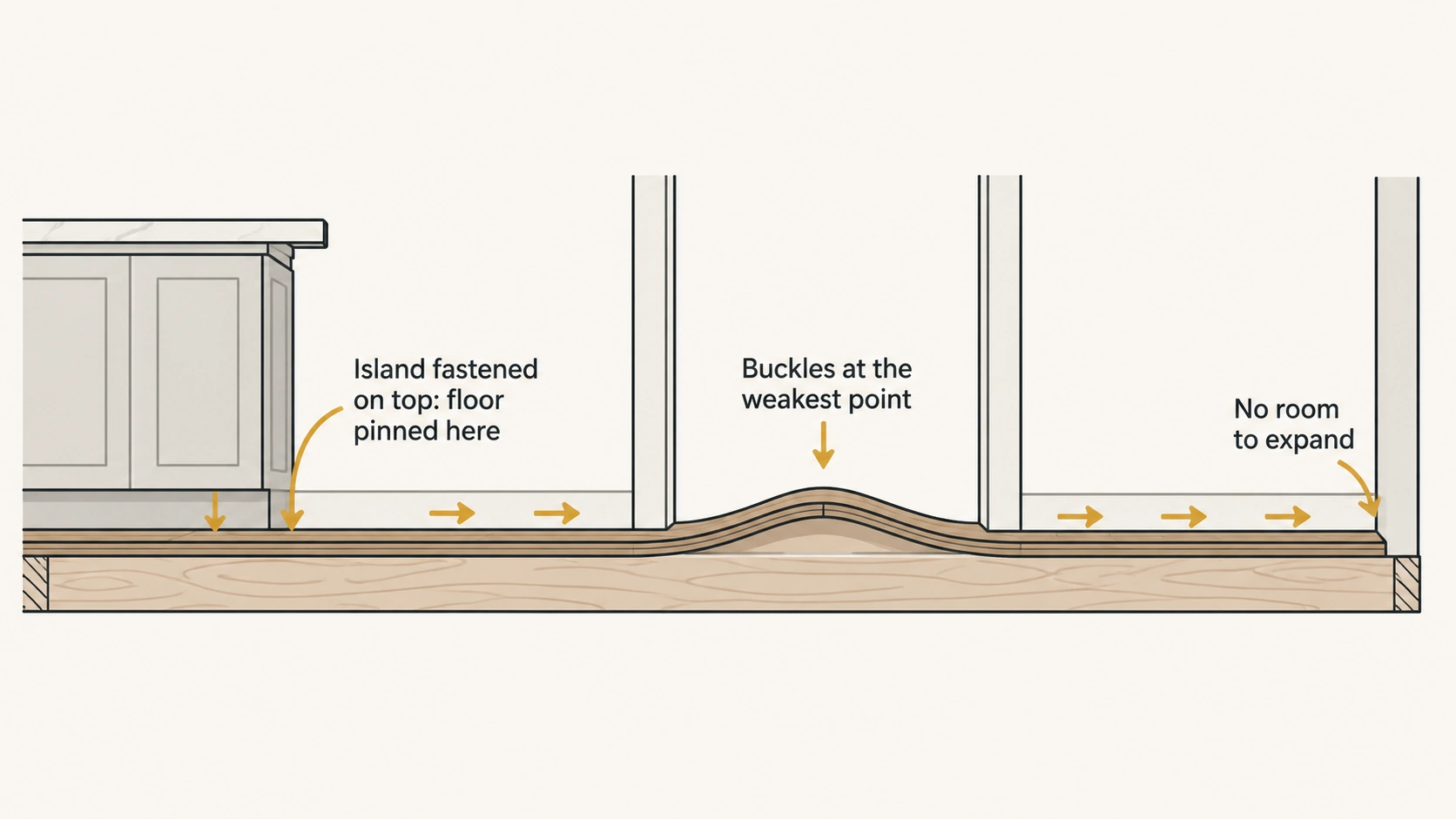
Most LVP is a floating floor. The planks lock to each other, not to the subfloor, and the whole floor moves as one sheet as the house warms and cools through the year. The movement is small, but it has to have somewhere to go.
It loses that freedom in a few ways:
No expansion gap at the walls. A floating floor needs a gap around the entire perimeter, hidden under the baseboard or quarter round. Butt it tight to the walls and the first warm spell pushes it up.
Something heavy fastened on top of it. Kitchen cabinets and islands installed on top of a floating floor pin it in place. So does quarter round nailed down into the plank instead of into the baseboard, or a transition strip screwed through the floor. The floor still tries to move, the pinned spot cannot, and it buckles somewhere nearby.
A run that is too long. Manufacturers set a maximum length a floor can run before it needs an expansion break, and some require a break at doorways. Large open plans and long hallways are where this gets missed.
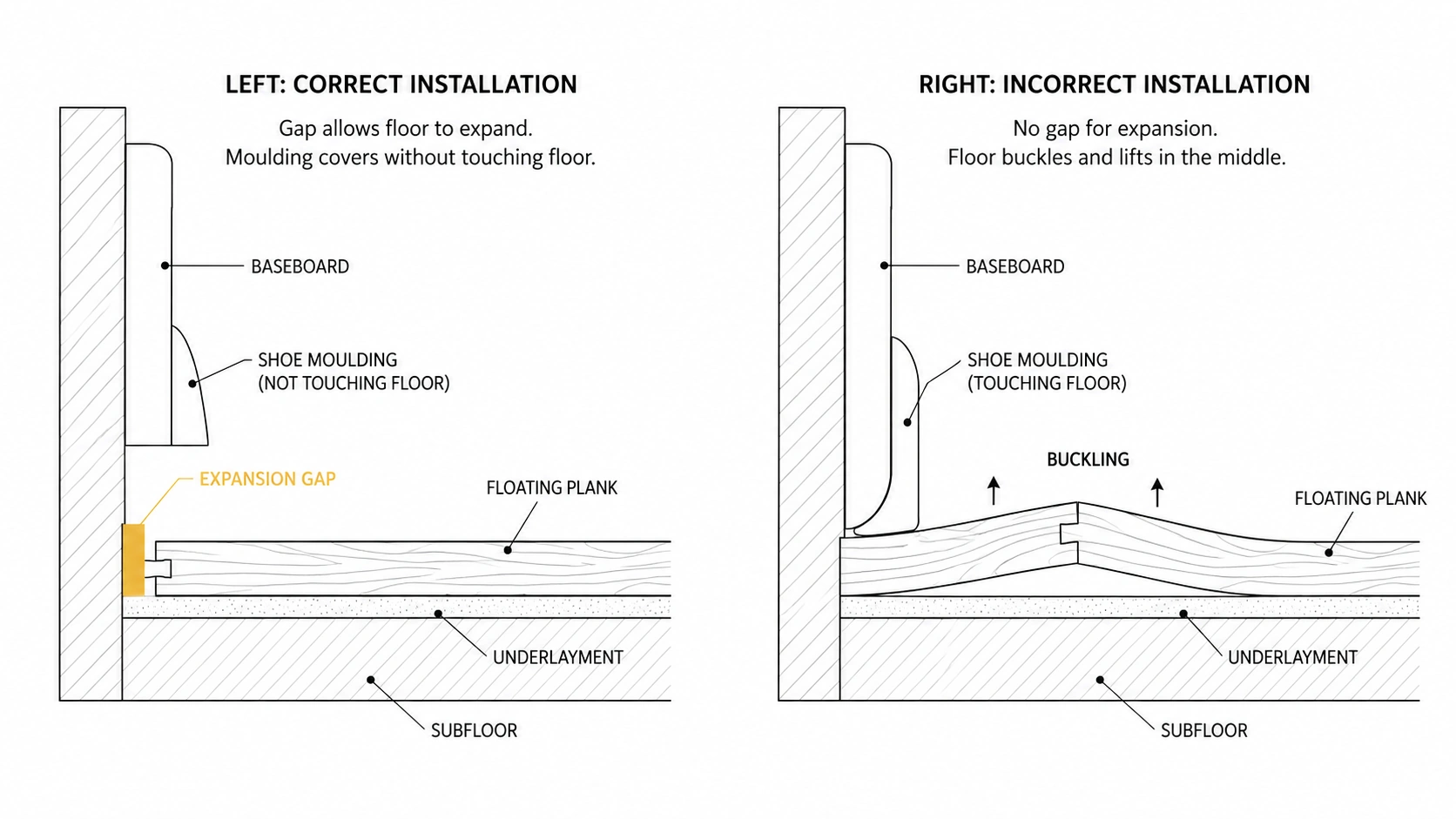
The good news is that a peaked floor is often fixable without replacing it. Find what is pinning it, free it, and restore the gap at the walls, and the floor usually settles back down. If the planks have creased or the joints have broken, those planks get replaced.
Clicking, popping and bounce: the subfloor was not flat
A floating floor sounds a little different from a glued one. That is normal. A pronounced click, a pop, or a spot that gives under your foot is not.
It means the plank is spanning a low spot. Every step flexes it, the locking joints tap against each other, and over a couple of years that flexing works the joints loose. That is how a line of separated planks appears across a room that looked perfect on the day it was installed.
Most manufacturers specify flatness within roughly 3mm over a 3 foot span. We check with a long straightedge in several directions at the estimate, because a dip found then costs a little self leveler, and a dip found after the floor is down costs a section of floor. Our guide to subfloor prep covers what that looks like on a real job.
Gaps between planks
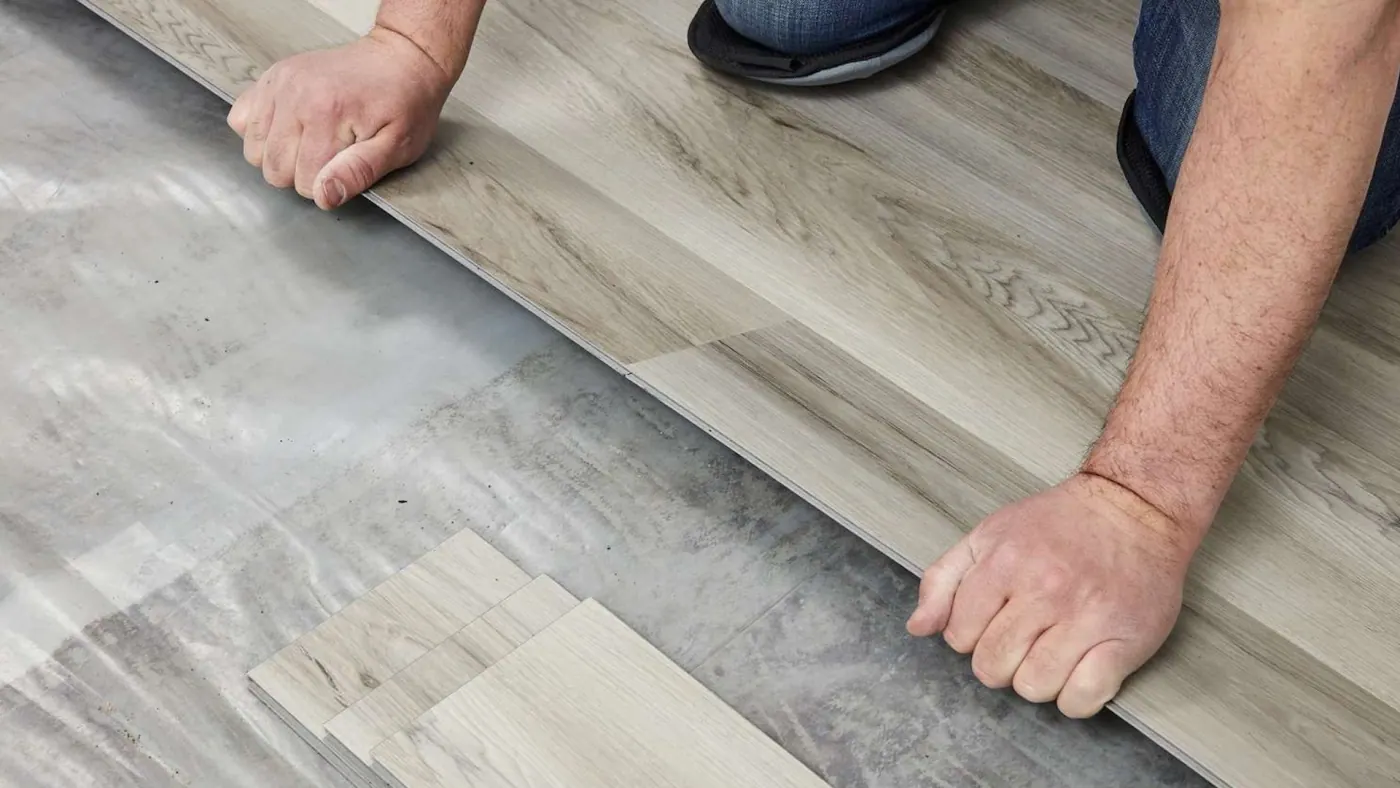
Gaps at the short ends of the planks usually come from one of three things.
Joints that were never fully locked. A click joint that is not seated all the way can look closed on install day and drift apart over the following weeks.
A pinned floor. When one part of a floating floor cannot move, the rest of it pulls away from that spot as it contracts in winter, and the gaps open on the far side.
Strong direct sun. A patch of floor in front of a south or west facing window can get far hotter than the rest of the room on an Oklahoma summer afternoon. Darker planks absorb more of that heat. The heated planks expand and contract much more than the floor around them, and the ends open up. Shades or blinds during the hottest part of the day prevent most of it.
The problems owners cause without knowing
None of these are installation faults, and all of them are avoidable.
Rubber backed rugs and mats. Some rubber and latex backings react with vinyl and leave a yellow or brown stain that does not come out. Use rug pads and mats labelled as safe for vinyl floors.
Steam mops. Many manufacturers advise against them, because heat and pushed moisture can work into the joints. Check your product’s care guide before you use one.
Dragging heavy things. Refrigerators, ranges and loaded furniture dragged across the floor will scratch even a thick wear layer. Use felt pads on furniture legs and lift or slide appliances on a protective sheet.
Dents fall somewhere in between. A rigid stone based SPC core resists dents from heavy furniture better than a softer WPC core, so if you have heavy pieces or a piano, that should shape the product choice. Scratches come down to the wear layer thickness, which our guide to the best flooring for homes with dogs covers in detail.
Moisture on a slab
Luxury vinyl plank is waterproof. The concrete under it is not dry.
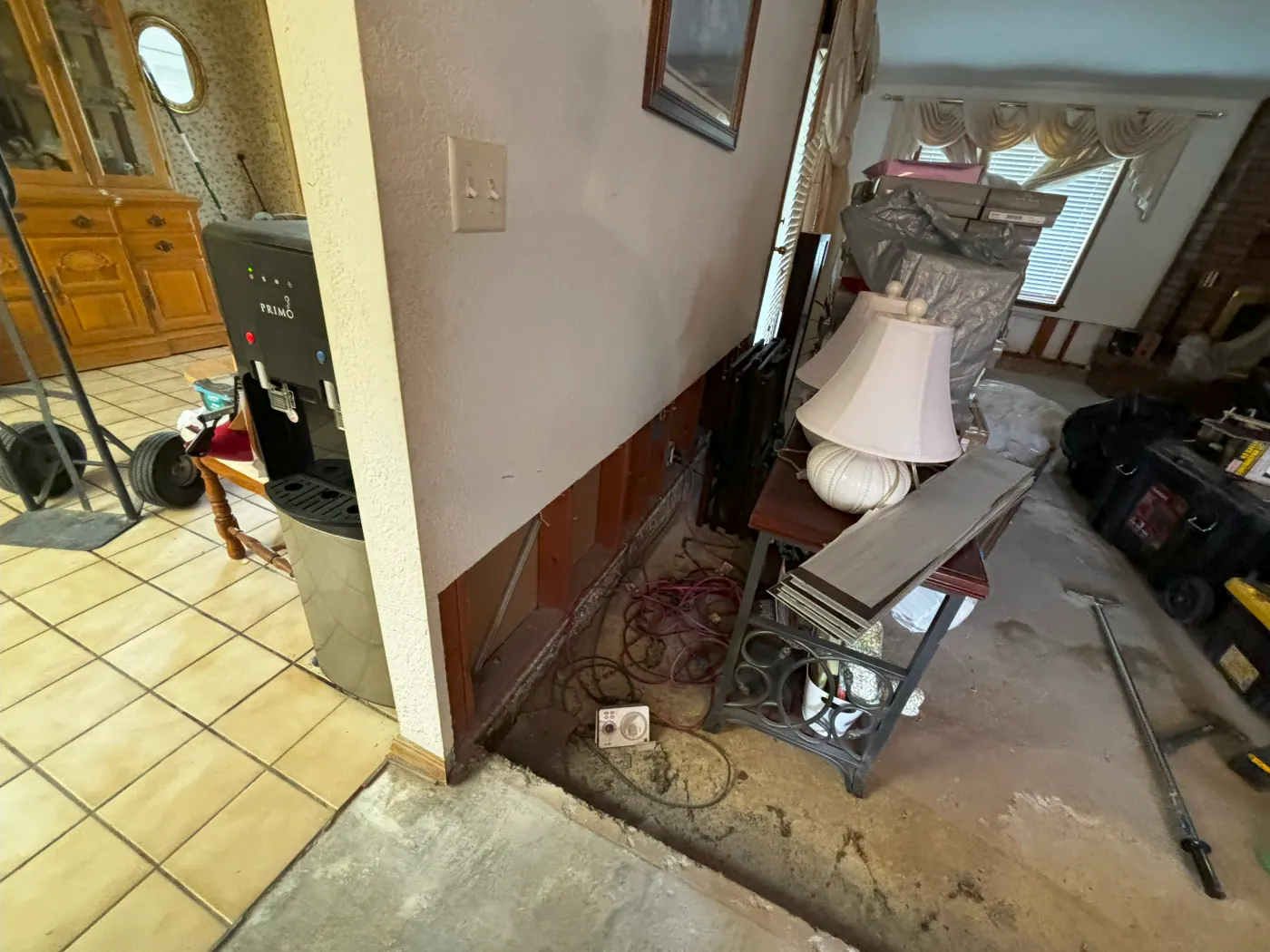
A slab keeps releasing moisture upward long after it is poured. A waterproof plank does not stop that moisture, it just stops it from coming through the floor, which means it can collect underneath. A musty smell, discoloration at the edges, or dampness when a plank is lifted all point here.
That is why we take a moisture reading on every slab at the estimate, and why the vapor barrier or underlayment follows the manufacturer’s instructions for concrete. A floor that skipped this step usually has to come up to be fixed.
Can it be repaired?
Usually, yes, at least in part.
On a floating click floor, planks can be unlocked from the nearest wall back to the damaged one and replaced, then the floor is relaid. On a glued floor, the damaged plank is cut out and a new one bonded in place.
Either way, the match is best with planks from the same production run, because color can vary slightly between batches. If you have a leftover box from your install, keep it somewhere dry. It is worth more than it looks.
Is it covered by the warranty?
This is the part most people find out too late. Product warranties generally do not cover installation problems. They typically cover manufacturing defects and the surface wearing through, and typically exclude damage from the installation, the subfloor, moisture and sunlight.
So the question to ask before any floor goes in is not just “what is the product warranty,” it is “what does the installer stand behind if the floor peaks or separates.” Our seven questions to ask a flooring installer covers how to ask that and what a good answer sounds like.
The short version
Peaking or buckling: the floor is pinned or has no room to move. Often fixable.
Clicking, popping or bounce: the subfloor was not flattened. The dip has to be corrected.
Gaps: unlocked joints, a pinned floor, or hot sun on one spot.
Stains, dents and scratches: usually how the floor is used, or a product that was too light duty for the house.
Moisture on a slab: a step that was skipped before installation.
If your floor is showing one of these and you want a straight answer on the cause, we will come look at it. And if you are about to put new LVP in, we check flatness and moisture at the estimate so these problems are caught before the floor goes down, not after. Call (918) 219-4848 or request a free estimate. You can read more about the product itself on our luxury vinyl plank page.