- Hardwood
- Care
Oklahoma Humidity and Why Hardwood Floors Move
Gaps that open in February and close again in July are the floor working correctly. Here is how to tell those apart from the ones that are not.

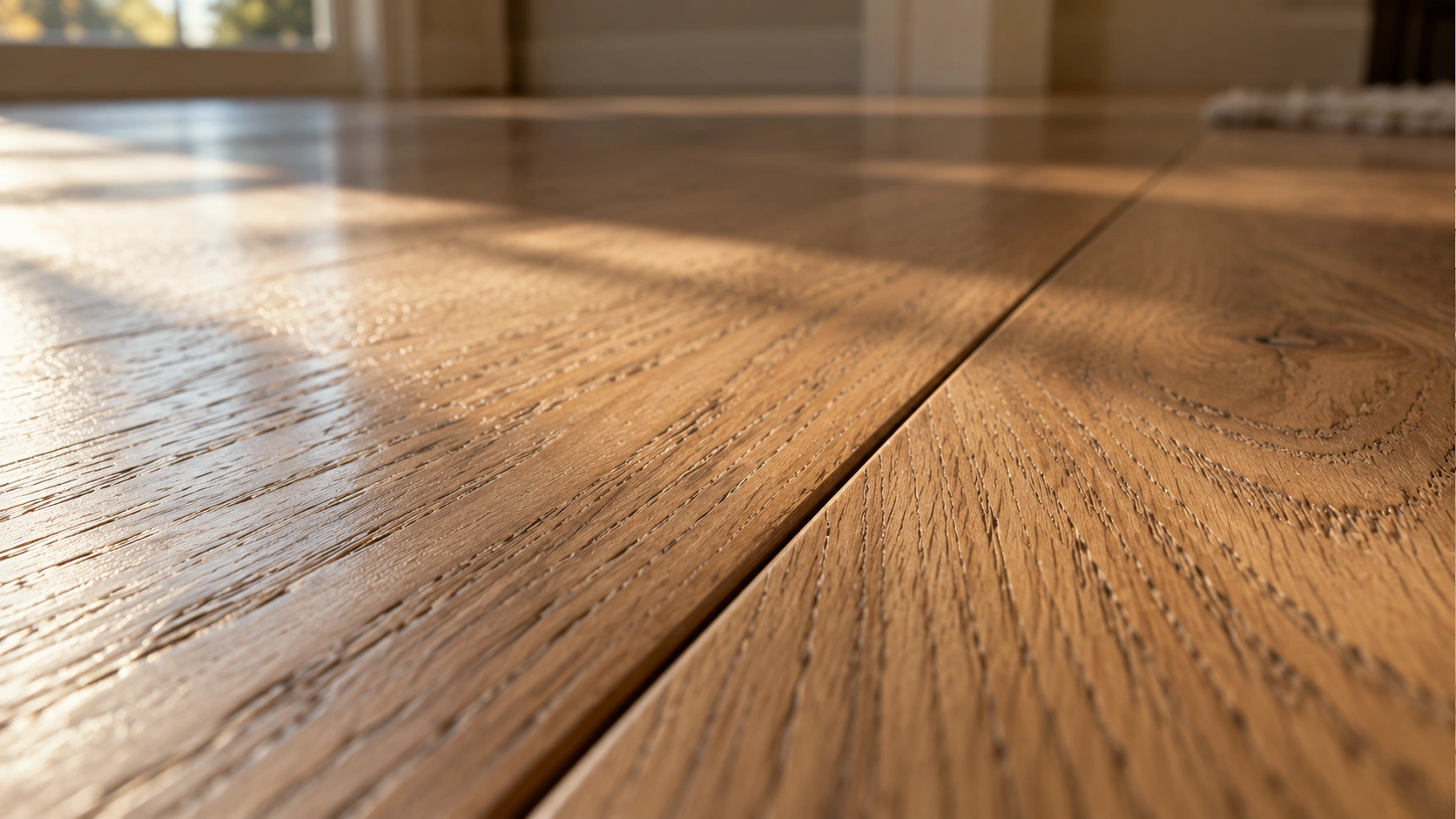
If gaps appear between your hardwood boards every winter and close up again by summer, your floor is not failing. It is doing exactly what wood does.
In Oklahoma it does it more than in most places, because our indoor air swings further. Humid summers, then months of heated winter air that gets genuinely dry. A wood floor breathes with all of it.
The useful question is not whether your floor gaps. It is whether the gaps you have are the seasonal kind or the other kind.
What is actually happening
Wood is hygroscopic, which is a long word for a simple behavior: it absorbs moisture from damp air and releases it into dry air, and it changes size as it does.
The change happens almost entirely across the width of a board rather than along its length. A board that is five inches wide in August might be a few hundredths of an inch narrower in February. On one board you would never see it. Multiply it across forty boards in a room and the total is very visible, because all that shrinkage collects in the joints between them.
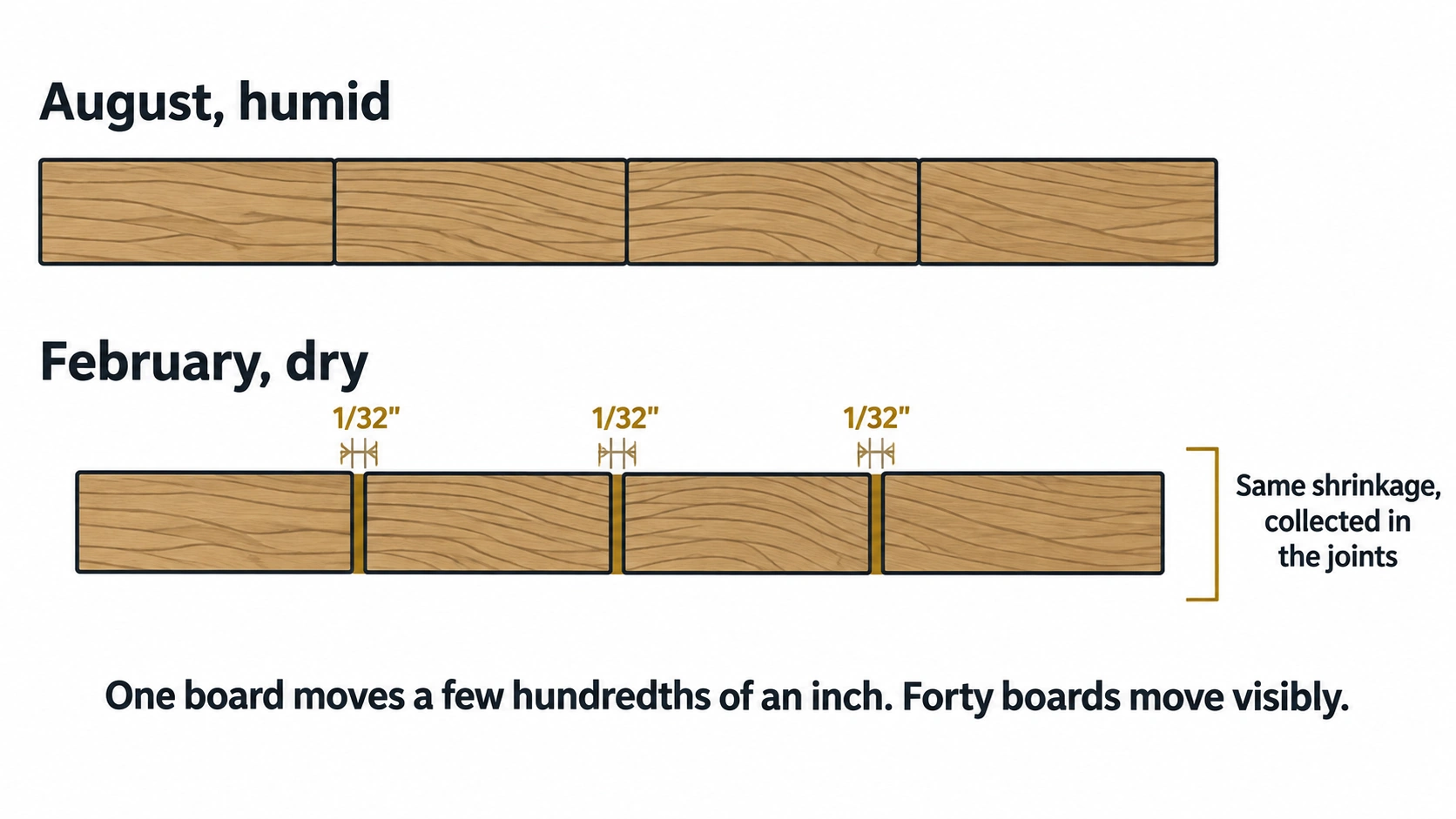
That is why gaps look worse across a wide room than a narrow one, and why they are more noticeable on wide plank floors than on narrow strip flooring. Wider boards move more individually, so each joint carries more of the total.
The National Wood Flooring Association publishes the moisture and humidity guidance the whole trade works to, and the short version is that wood is stable when the air around it is stable. Oklahoma air is not.
The Oklahoma part
Two things make this more pronounced here than the national advice implies.
The summer to winter swing is large. Outdoor humidity through an Oklahoma summer is high, and winter heating drives indoor relative humidity down hard. The floor sees both ends.
Houses sit empty during the day. A lot of the homes we work in run the HVAC harder in the daytime with nobody home, cycling the air and drying it further. That is a bigger factor than most people expect, and it is why two identical floors on the same street can behave differently.
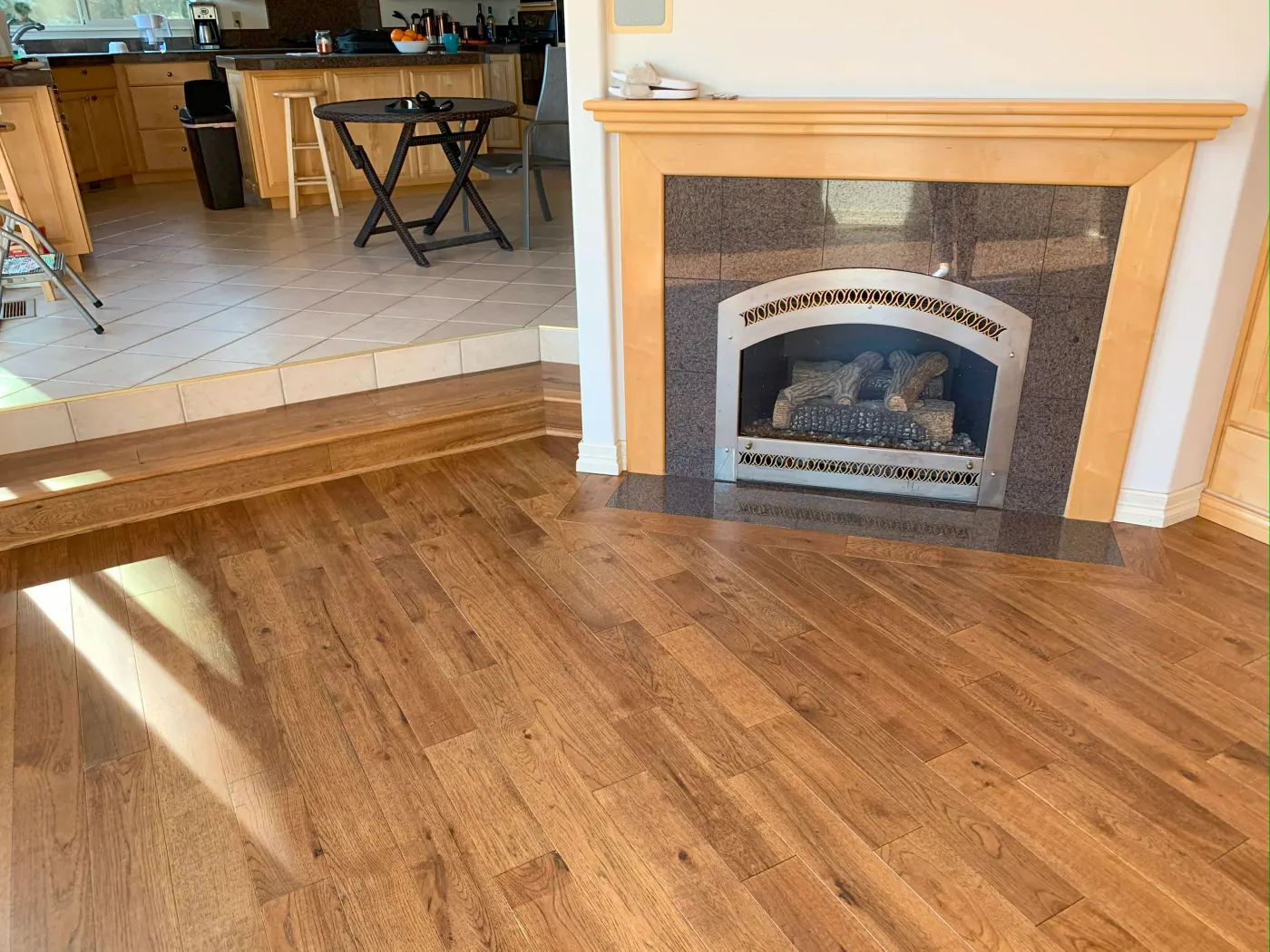
Add a fireplace or a wood burner and the room it is in will gap more than the rest of the house. That is not a coincidence and it is not a defect in that section of floor.
Seasonal or not? How to tell
This is the part worth knowing, because it decides whether you need to do anything at all.
| What you see | Likely cause | What to do |
|---|---|---|
| Even gaps across the room, widest in late winter | Normal seasonal shrinkage | Nothing. They close in summer |
| Gaps that close noticeably by August | Normal seasonal movement | Nothing. Consider a humidifier if the winter look bothers you |
| Gaps the same width in August as in February | Boards installed too wet, or a lasting moisture change | Worth a proper look |
| Gaps widening year over year | Ongoing moisture loss, or fasteners letting go | Worth a proper look |
| One or two large gaps, rest of floor tight | A board or a run that has moved, often near a heat source or an exterior wall | Localized repair, not a whole floor issue |
| Boards cupped, edges higher than centers | Moisture from below, often a crawlspace or a slab | Find the moisture source before touching the floor |
| Boards peaked, centers higher than edges | Expansion with nowhere to go, usually a missing gap at the walls | Needs the perimeter opened up |
The single most useful test is time. Mark one gap with a pencil line on the board at each edge, note the date, and look again in August. If it has closed noticeably, the floor is seasonal and healthy.
Why filling gaps in winter is a bad idea
This comes up every January and the honest answer costs us work, so here it is.
Filling seasonal gaps when they are at their widest means putting filler into a space the wood intends to reclaim. Come summer the boards expand and find that space occupied. The pressure has to go somewhere, and it goes up. That is how you turn a floor that gapped into a floor that cups or peaks, and the second problem is far more expensive than the first.
There is a narrow case where filling is right: gaps that stay open all year, in a floor that is no longer moving seasonally. Even then it is done in the humid part of the year, when the boards are at their widest, so the filler goes into the smallest version of the gap.
If someone offers to fill your gaps in February, ask them what happens in July.
What actually reduces it
A whole home humidifier. This is the only real prevention, and it works because it attacks the cause rather than the symptom. Holding indoor relative humidity in a narrower band through winter means the wood moves less. A unit on the furnace does this far better than a portable humidifier in one room, which mostly humidifies that room.
Running the house at a steadier setting. Big daily temperature swings dry the air harder. This is a small effect next to the humidifier but it is free.
Choosing the right product up front. Engineered hardwood moves substantially less than solid, because the cross ply core restrains the wear layer. On a slab it is the only sensible choice anyway, and in a house that gets very dry in winter it is worth considering even where solid would work. We compare the two in engineered vs solid hardwood for Tulsa slab homes.
Narrower boards, if the look suits you. A three inch board moves less at each joint than a seven inch board. Wide plank is beautiful and we install a lot of it, but it will show more seasonal movement. That is a trade worth making knowingly.
Installing in the fall. Wood acclimated in the fall starts near the middle of its yearly range, so it has less distance to travel in either direction. More on that in the best time of year to install flooring in Oklahoma.
What we do about it at install
Three things, and they are the reason a proper quote costs more than a fast one.
We take moisture readings. Both the subfloor and the wood, before anything goes down. Numbers, not a guess by feel.
We acclimate the material in the room. In the actual space, at the temperature and humidity that space will normally hold, until it stops changing. Not in a garage, and not for a fixed number of days regardless of what the meter says.
We hold a real expansion gap at the perimeter. All the way around, at every wall and every fixed object, hidden behind the baseboard and shoe. This is the detail that decides whether summer expansion has somewhere to go. It is also the fastest corner to cut, because nobody can see it once the trim is on.
If a hardwood quote does not mention moisture readings or acclimation anywhere, that is worth asking about before you sign it.
The short version
Gaps in February that close by August: normal, especially in Oklahoma. Do nothing.
Gaps that never close, or that keep growing: get it looked at.
Cupped or peaked boards: find the moisture or the missing expansion gap first. The floor is a symptom.
Filling seasonal gaps in winter: almost always the wrong move, and it can turn a cosmetic issue into a structural one.
Prevention: a whole home humidifier, and engineered rather than solid in a house that runs dry.
If you have a floor doing something you are not sure about, we are happy to look at it and tell you honestly whether it needs work. Call (918) 219-4848 or get in touch. We install rather than refinish, so if the answer is that your floor needs sanding rather than replacing, we will say so and point you the right way. You can see the wood floors we install on our hardwood flooring page.