- Luxury Vinyl Plank
- Buying Advice
LVP on Stairs: Is It a Good Idea?
Yes, when it is done as stair work and not as floor work. A stair is the one place a floating plank cannot float.

Yes, luxury vinyl plank works well on stairs. It looks good, it wears well, and it lets the stairs match the floor they land on. The catch is that a stair is the one place a floating plank cannot float. Done as stair work, it is a great result. Done as floor work, it is the part of the job that fails first.
Here is what changes on a staircase, and the questions worth settling before anyone starts.
Why stairs are different from floors
On a floor, LVP floats. The planks lock to each other and the whole floor moves slightly as one sheet through the seasons. That is exactly what you do not want on a stair, where every tread is a separate small surface that takes a footstep on its front edge many times a day.
So on a stair, each piece is bonded down to the tread and riser following the manufacturer’s stair instructions, and the front edge of each tread is finished with a stair nosing. That changes three things compared with the rest of the house:
It takes longer. Every tread and riser is measured, cut and fitted individually. A staircase takes a share of the schedule out of proportion to its square footage, which is why it shows up separately in our guide to how long flooring installation takes.
The nosing is where it succeeds or fails. It is the most visible and the most worn part of any staircase.
It is usually priced per step, not per square foot, because the work is in the fitting rather than the area.
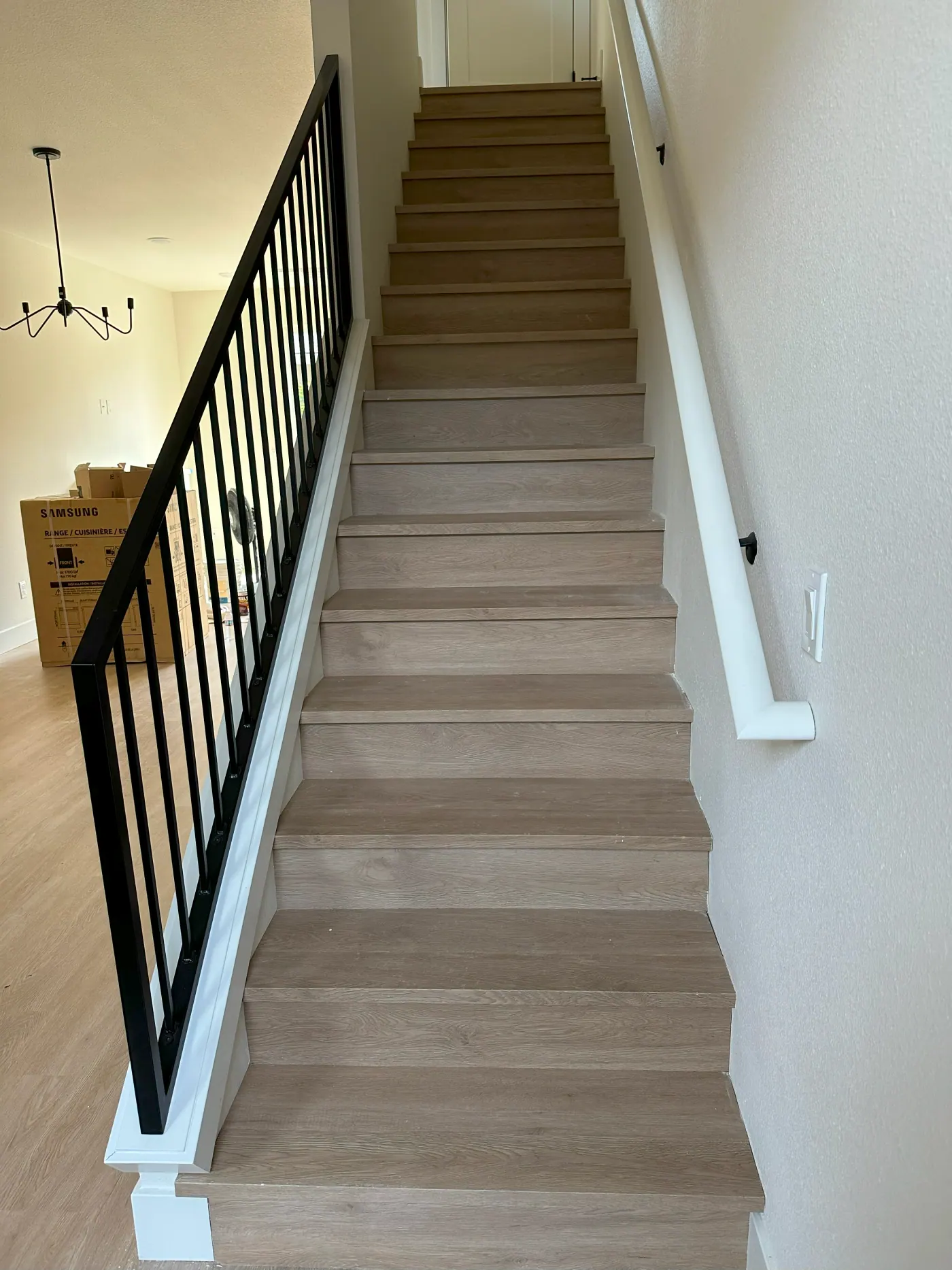
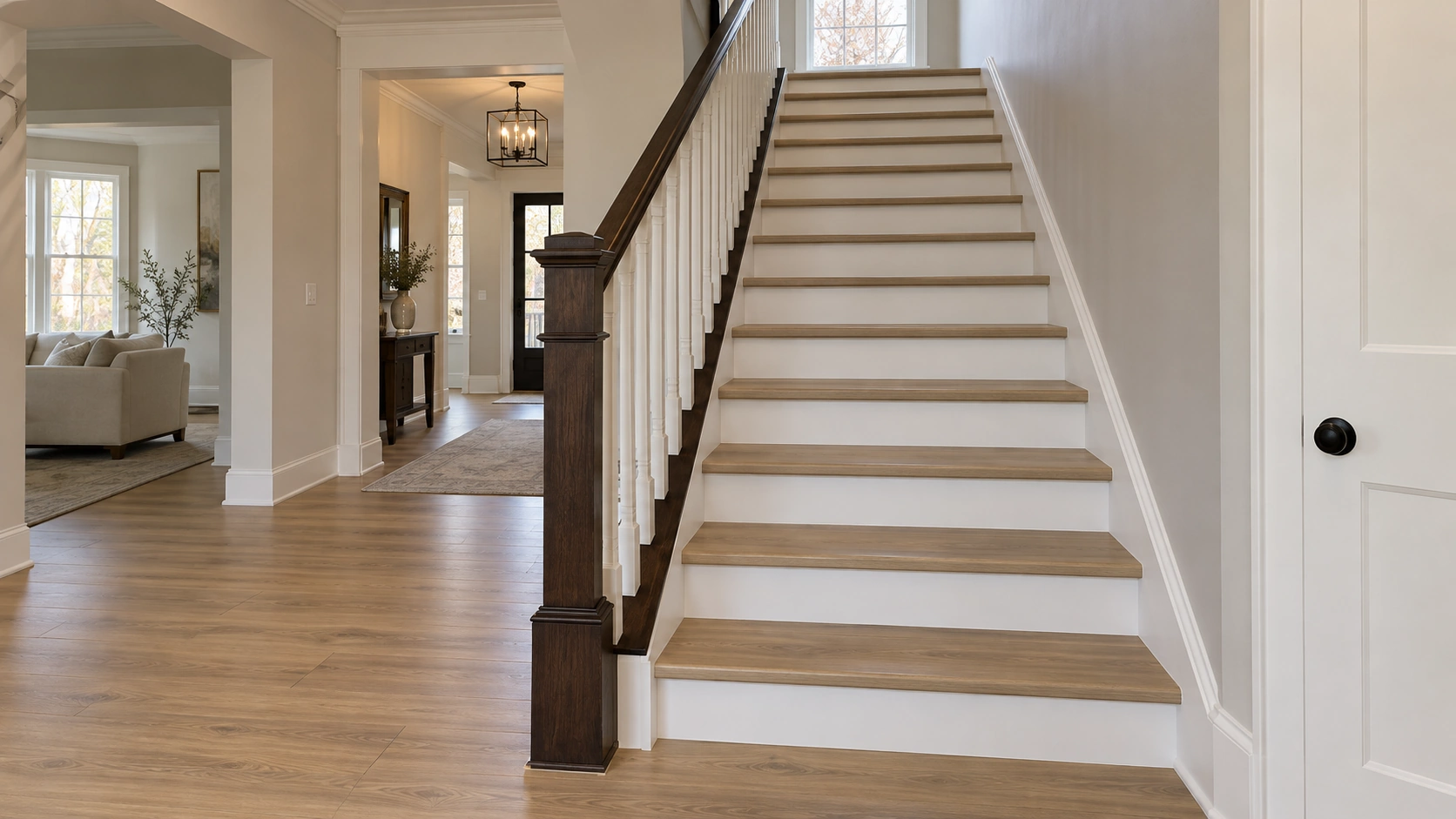
That staircase is one of ours. The treads and risers are finished in the same plank as the floor they land on, so the stairs read as part of the floor rather than a separate surface.
Stair nosing: the part that decides how it looks
The nosing is the profile that wraps the front edge of each tread. There are a few types, and the right one depends on what is already there.
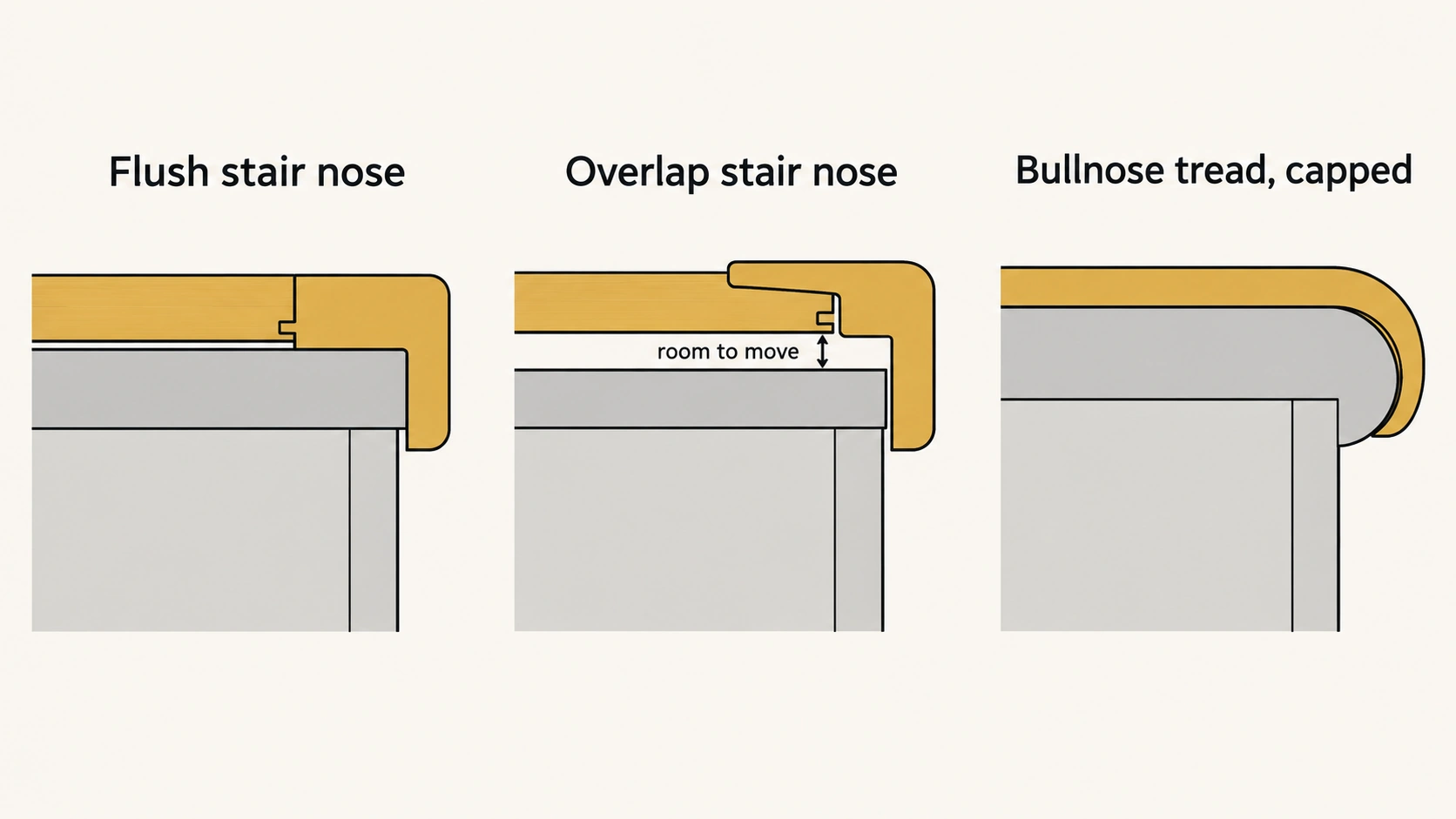
Flush stair nose. Sits level with the plank on the tread, for a clean, built in look. This is what you want on most treads.
Overlap stair nose. Sits slightly over the edge of a floating floor, which is what is needed at a landing or the top step where the stair meets a floor that still needs room to move.
Existing rounded treads. Many staircases have treads with a rounded front edge that overhangs the riser, often called a bullnose. New plank cannot simply be laid over that edge. It is either cut back so a proper nosing can go on, or capped with a retrofit system designed for it.
Whatever profile is used, it should match the plank. Stair nosing and transitions are where cheap installs show, which is why we match the nosing to the floor rather than reaching for a generic strip that is close enough.
Is LVP slippery on stairs?
It can be. Most of the complaints come from smooth, glossy products and people walking down in socks.
Three things make the biggest difference:
The surface finish. A matte or textured plank grips far better than a high gloss one. Feel the sample, do not just look at it.
The nosing edge. A nosing with a defined edge gives your foot something to find, which matters more on the way down than the way up.
Light. A clear view of the edge of each step prevents more slips than any material choice.
If anyone in the house is unsteady on stairs, a fixed runner down the middle of the treads is a sensible answer, and some people just prefer the look. It is easier to plan a runner before the stairs are finished than to add one after.
Replacing carpet on stairs: what is usually underneath
A lot of staircases getting LVP are coming out of carpet, and what is under the carpet decides a good part of the job.
In many builder grade homes, carpeted stairs were never meant to be seen. The treads underneath are often rough construction material rather than finished wood, with a rounded overhanging front edge, plus tack strips and a lot of staples. All of that comes out or gets dealt with before anything new goes on.
None of that is a problem. It just means the stairs need to be looked at with the carpet in mind, because what is under it changes both the method and the price.
Spindles, balusters and open sides
If the spindles sit on top of the treads, there are two ways to handle them.
Work around them. Each tread piece is cut to fit precisely around the spindles. This keeps the railing untouched, and it takes careful cutting.
Remove and reset them. The spindles come out, the treads are done, and the spindles go back in. This can give a cleaner result, depending on how they are fastened and what condition they are in.
Stairs with an open side, where the ends of the treads are visible, also need a return on each tread so the side looks finished. All of this is worth deciding at the estimate, not on install day.
The riser height rule nobody mentions
This is the one most people never hear about, and it is a safety issue rather than a cosmetic one.
The residential building code limits how much riser heights can vary within a single flight of stairs, to no more than 3/8 inch between the tallest and the shortest. Your feet expect every step to be the same height, and a step that is off by more than that is a trip hazard.
Now think about what new flooring does. Put a new floor on the landing at the top, or on the floor at the bottom, and you change the height of the top or bottom step, but not the ones in between.
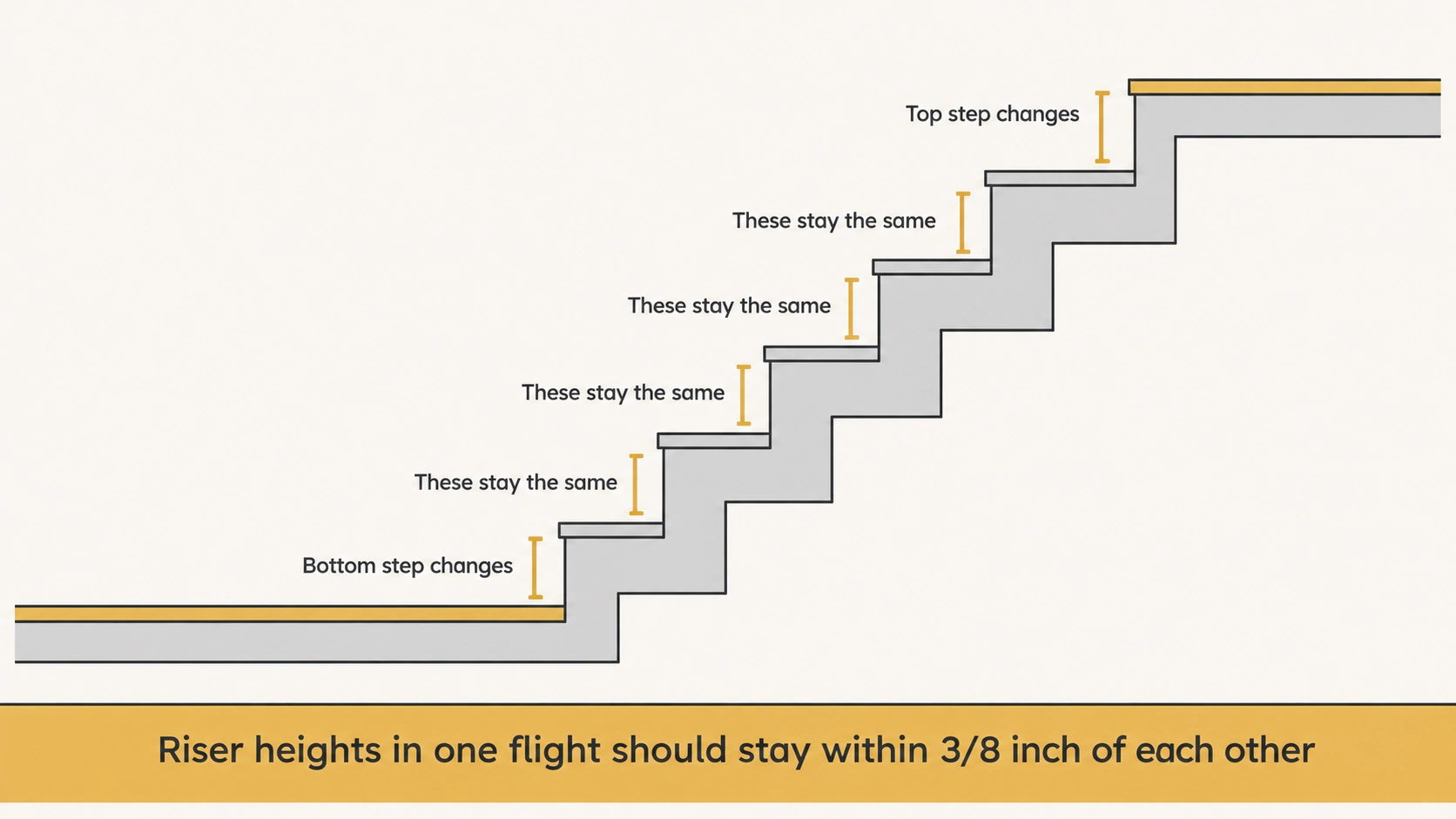
On most jobs the difference is small and stays well within the limit. Where it gets tight is thicker flooring, a floor going on top of an existing floor, or a staircase where one step was already a little off. It is the reason flooring thickness on stair jobs should be decided with the stairs in mind, not just the rooms.
Does LVP wear well on stairs?
Well, with one caveat. A staircase concentrates foot traffic onto a small area, and the front edge of each tread takes most of it. The nosing is the first thing to show wear.
That makes the wear layer matter more on stairs than almost anywhere else in the house. Our luxury vinyl plank page explains how to read a wear layer rating, and our guide to the best flooring for homes with dogs covers what holds up to heavy use.
Doing the landing without the stairs
You do not have to do both at once. A common approach is to put LVP on the landing and upstairs hallway and leave the stairs carpeted for now, finished with a clean transition at the top step.
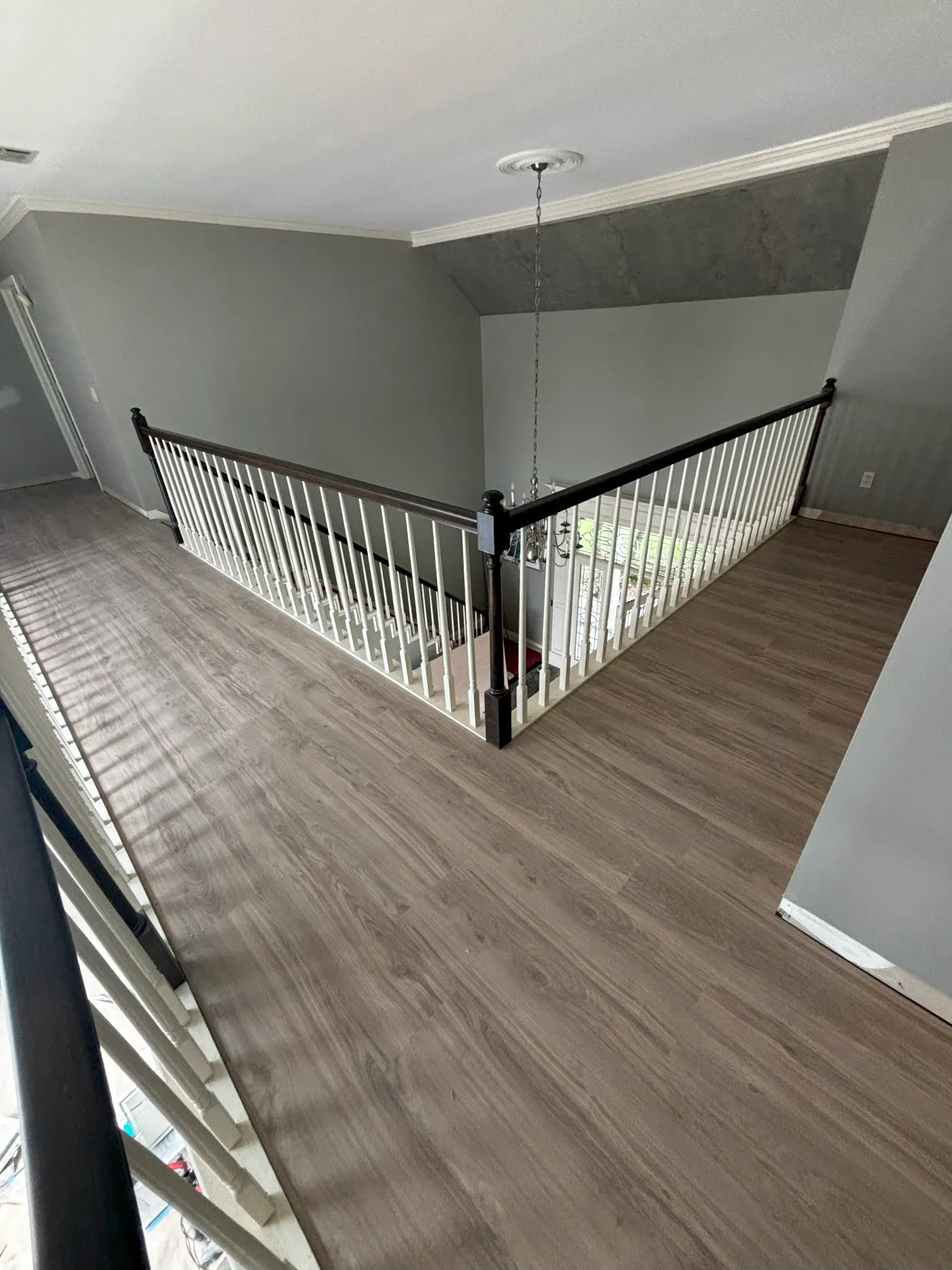
That landing is one of ours. The plank runs right up to the top of the stair and the railing, and the stairs below kept their carpet. It is a sensible way to split a project, as long as the top step transition is planned so the stairs can be done later without redoing the landing.
So, is LVP on stairs a good idea?
Yes, if each tread is bonded down, the nosing matches the plank, the product has a wear layer that suits a staircase, and the riser heights are checked against the new floor.
Think twice if you want the absolute grippiest surface in socks, in which case choose a textured plank or plan a runner, or if the stairs are a showpiece in a high end home where real wood treads will read differently.
If you want stairs that match your floor, we will come look at them, check what is under the carpet, and give you a written line item quote with the stairs itemized so nothing is vague. Call (918) 219-4848 or request a free estimate, and you can see more of our stair work on our recent projects page.